“You work agency-side for a few years to get good, then go in-house for better money and an easier life;” sage wisdom we’ve all heard before. Landing that coveted in-house role is like riding off into the sunset for many a marketer.
If you’re ambitious, that might ring alarm bells. Does that mean you stop improving once you go in-house? Is going soft the price of comfort and better pay?

It doesn’t have to be. But it definitely changes what “good” looks like, and since improvement is “getting more good” that ends up looking different too.
Having just made the change myself, this has been on my mind a lot. I didn’t expect to end up in-house so soon in my career, and I’ve got a lot more growth planned for myself yet. I don’t expect my day job to push me hard enough on its own any more, as much as I enjoy it (and as much as it’s not always a picnic). Here’s what I’ve learned so far, and how you can apply it to your own grand ambitions.
The challenge: turn less into more
An in-house job is likely to push you less (in terms of deadlines and the number of priorities you have to juggle, at least). What that does is open up the opportunity for you to push yourself.
If you haven’t been proactively seeking growth, instead letting a breakneck-pace agency role pull you along, this will need to change. An in-house role can often be done at a sensible pace from 9-5 and the standard of your work will be more than good enough. It’s a nice life, but your organic growth can stall.
What this translates to, however, is more time and autonomy to do the best possible version of the work you’re doing. Doing less work, better, is always nice. If you want a real edge though, you need to keep exposing yourself to a whole range of stimuli that you can bring into that work.
There’s also a chance you’ll lose sight of how your own skills compare in the market. Without pitches to win or lose, client churn to monitor and a range of accounts to flex your skills on, it’s hard to know where you stand. If you can keep your finger on the pulse, it’ll be a great motivator one way or another. The answer to this bit is fairly simple:
Talk to other brands and marketers
When I’d not long been in-house, I got involved in a conversation online with someone trying to improve their GTM implementation. They had a few basic questions which turned into us jumping on a call for 30 minutes and working out a solution for their needs, and even some follow-up messages to make sure everything was right. It didn’t feel like I really stretched my ability that much, but the guys I spoke to found it super useful. That was a change in perspective.
My new role doesn’t strictly involve GTM, and I had no idea if my knowledge was even worth sharing with my new team. Seeing how useful it was to other marketers let me know I should speak up about it when it’s relevant.
Consulting let me speak to a competent paid marketer and a skilled developer and realise I still had good input to bring to the table by telling them things they didn’t already know.

I hadn’t even realised some of my knowledge was specialised and worth sharing like that. Being stuck in one set of responsibilities, even agency-side, can make it easy to forget what else you’re capable of. You never know how you’re taking yourself for granted.
If consulting sounds like a bit much, you can just get involved with conversations happening LinkedIn or wherever you’re comfortable. Provide value for other people; you’ll be blown away by how much you can contribute and it’ll let you go about your whole job more confidently.
If you want to charge for it, go right ahead. It can only be more worthwhile if you do.
Grow your comfort zone
Once you’re in-house, your thinking will be applied to a single niche and you’ll start to work the same way all the time. Applying the same ideas becomes the path of least resistance for your brain, and you’ll get better at doing it. But you’ll grow predictable like that.
That’s how muscle memory develops: by firing the same neurons over and over, your nervous system can do it faster and more efficiently. But watch out; it gets tempting to do the same thing every time, since it’s what you’re best at. That leads to uninspired work.
Force your brain to do something totally different, approach a problem from the total opposite angle to the way you normally would. It’ll keep your thinking flexible and give you multiple kneejerk reactions to choose from instead of just one.
In the past, this was demanded of you by working on different clients and needing fresh ideas at short notice.
In-house, you might have to ask yourself “what if the thing we usually do was impossible?” or take tactics out of the equation and imagine you were pitching this work for the first time.
If you went from scratch, knowing little about the current approach, what would you recommend? There’s bound to be something you can bring into play.
Go outside of the job spec
Once thing’s very likely to be true about your new team; you’ll be the only one with your exact background.
There are experiences you’ve had, and can relate to the job, that are uniquely yours. You can bring fresh perspective just by adding yourself into the mix.
Consider your old agency’s standard playbook. Is there anything which would make for a quick win here?
What about stuff the agency wouldn’t let you do, or that there just wasn’t time for? You’re probably about to have a lot more time. Consider what’s possible.
These ideas probably came up when you interviewed, and set you apart from the competition. They aren’t in the job spec, but they’re likely what got you the role.
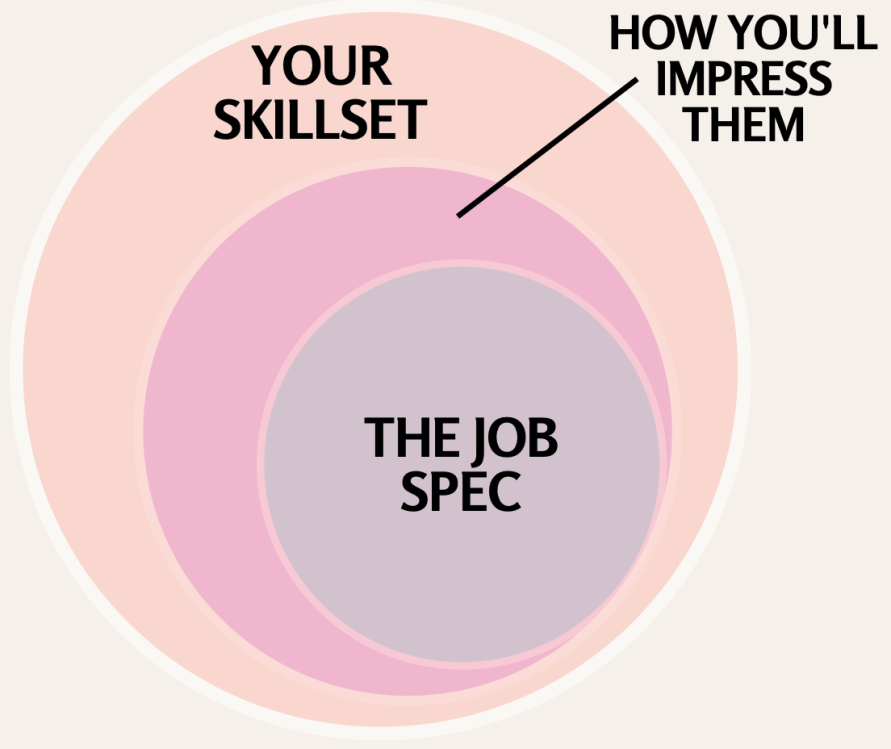
It’s easy in the early stages of a job to focus on getting the basics right and ticking the right boxes to settle into the team; that makes sense. Just make once you’ve got the basics nailed, you be the person they hired.
We all talk a big game during job interviews and it’s easy to slip into a more standard level of working once you’ve got your feet on the ground, but it doesn’t have to be like that. Make a note of your big ideas early on, and revisit them when you understand your new role well enough to action them.
Settle your old grudges (sort of)
When you’re agency-side, you’ll usually be responsible for a small part of the customer journey. If a different part of the journey is shit and holds conversion rates back, or demand for the product is low, you’re expected a magic up a solution to that within your little silo. Annoying.
In-house, you’re able to move outside of your silo much more freely and try to actively influence this other stage of the journey yourself.
Think about it; this interplay is usually the justification full-service agencies give for why you should work with them over a set of smaller teams. That doesn’t always hold up to scrutiny in practice, because of how frantic agency life can be. In-house, that excuse disappears.
When you’re agency-side, your goals aren’t really aligned with the client’s as well as they could be. We all try to make it work, but where the client wants what’s best for their business, you have to focus on making sure the next invoice gets paid by delivering something right now. If that means scrimping on quality, so be it.
In-house, your goals really are the same as the rest of the marketing team.
It’s the perfect time to revisit those problems you used to have around checkout experience or social presence. This time, you’ll actually be empowered to do something about them by working cross-functionally.
Again, this is the sort of work that sometimes gets overlooked in a job spec, but sets the great in-house marketers apart from the average ones.
If you want to stand out, and get 100% out of your own channel in the process, this is how you do it. If you’re eyeing a promotion, it’s basically mandatory. Get your teeth into the bigger picture!
It’s what you make of it
In short then, going in-house is still a huge opportunity to keep growing your skills. The difference is in how these opportunities present themselves; or often, don’t present themselves unless you go looking.
Start by nailing the basics. It’s no good trying to change the world on day one at the expense of your core responsibilities.
After that, you need to be looking in all directions for things you can improve. Be tactful- these things are probably somebody else’s core responsibility! If you rip it all to shreds, don’t be surprised if you’re left out of the team Secret Santa next year.
Make sure whatever you’re suggesting works for both teams’ goals, and add whatever value you can to make sure there’s something in it for both sides of the project. Otherwise, you’re just asking people to make your results better for you.
All along the way, keep your finger on the pulse in the wider industry: talk to people, help them solve their problems, understand what you’re each doing that the other isn’t.
It’s easy to lose sight of what ‘average’ even looks like when you’re going it alone or part of a small team, so this contact with the outside world is invaluable.
Maximising an in-house role is simple to understand but difficult to execute well. If you can do everything we’ve gone over here, you should still have no trouble nailing it. Good luck!
 Joe Robinson: Bald Guy, Marketer, Self-Improver.
Leave a comment